What is GST in India? A Simple Guide in 2025

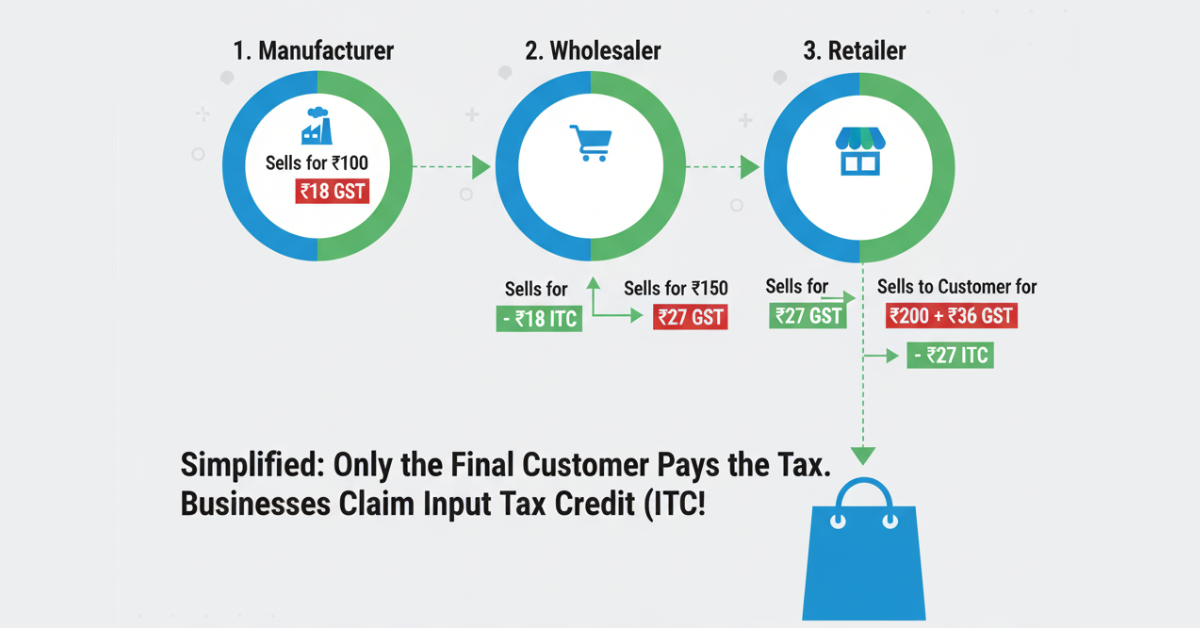
Have you ever bought a packet of chips for ₹20 and noticed “GST” written on the bill? Or maybe when you went shopping, the shopkeeper said, “18% GST extra.” But what is GST really? Why do we pay it? And where does that money go? Let’s break it down in simple words.
GST: The Tax That Changed India Before 2017, India’s tax system was complicated. Every product had different taxes at every step excise duty, VAT, service tax, luxury tax, entry tax which was confusing for both businesses and customers.
To simplify this, the government introduced the Goods and Services Tax (GST) on 1st July 2017. Since then, GST has become the single indirect tax system that covers most goods and services.
Think of GST as a “one nation, one tax” model. Instead of paying dozens of small, hidden taxes, we now pay one transparent tax that applies across the country.
How Does GST Work? The Smart Part
Imagine you buy a shirt:
- The manufacturer makes the shirt and pays GST on raw materials (cloth, buttons, thread).
- The wholesaler buys the shirt, adds their margin, and charges GST again.
- The retailer sells it to you, adds their margin, and you pay GST on the final price.
But here’s the smart part: GST is a value-added tax.
That means at every step, businesses get a credit for the GST they already paid earlier (called Input Tax Credit, or ITC). So, the tax burden of the old “tax on tax” system is eliminated, and only the final consumer you ends up paying the full GST.
Types of GST in India
Depending on whether goods or services cross state borders, GST is split into different types:
- CGST (Central GST): This part of the tax goes to the central government.
- SGST (State GST): This part goes to the state government.
- IGST (Integrated GST): This is for goods or services moving from one state to another (an inter-state transaction). The tax is collected by the central government and later split between the Centre and the destination state.
- UTGST (Union Territory GST): This is the equivalent of SGST for Union Territories without their own legislature (like Chandigarh).
So, when you pay GST, part of it supports your state, and part goes to the central government.
GST Slabs in 2025: Major Reforms!
In a landmark move, the GST Council approved significant reforms in September 2025, simplifying the tax system to make it fairer and easier to understand. The old four-tier structure (5%, 12%, 18%, and 28%) has been largely replaced with a streamlined model.
- 5% GST: This is the new rate for most essential items, including many packaged foods, household goods, dairy products, and medicines that were previously at 12%. This makes daily necessities more affordable for the common person.
- 18% GST: This is the new standard rate and applies to most goods and services, including consumer durables like ACs, TVs, and cars, many of which were previously taxed at 28%.
- 40% GST: A higher rate for select luxury and “sin goods” like tobacco, pan masala, and aerated drinks.
(Note: Alcohol and petroleum products are technically still outside the GST system, with states levying their own taxes on them.)
Why GST Matters for You
- Transparency: When you buy something, you know exactly how much tax you’re paying because it’s shown on your bill.
- Fair Prices: By removing the cascading “tax on tax” effect, GST has made prices more reasonable and competitive.
- Government Revenue: GST is a massive source of income for India. In FY 2024-25, India collected a record ₹22.08 lakh crore in GST, a vital source of funding for healthcare, infrastructure, defense, and other welfare schemes.
Challenges and Final Thoughts
Of course, GST is not perfect. Small businesses can find the filing process complex, and some exemptions (like petrol and alcohol) make the system less “one nation, one tax” in practice.
But despite these challenges, GST is a massive improvement from the messy tax system that came before it.
So, next time you see “GST” on your shopping bill, remember it’s not just tax. It’s part of building a unified national market and funding the roads, schools, and hospitals that are part of a growing India. At CrunchyFin, we believe understanding how taxes like GST work gives you the power to handle your money smarter, without the fear of hidden costs.