Sensex vs Nifty: A Beginner’s Guide to India’s Top Indices in 2025

Have you ever heard a business news channel say, “Sensex is up 500 points!” or “Nifty closed in the red at 22,100!”? If you’re new to investing, these phrases might sound like a foreign language. Don’t worry! This guide will explain what Sensex and Nifty are, how they’re different, and why they matter for Indian investors. By the end, you’ll be able to follow market news like a pro.
What is a Stock Market Index?
Think of the stock market as a massive cricket league with hundreds of teams (companies). It would be impossible to track every single team’s performance to understand how the entire league is doing. Instead, you’d look at the top teams to get a quick snapshot of the league’s health. That’s exactly what a stock market index does. It tracks a select group of companies to represent the overall market’s mood.
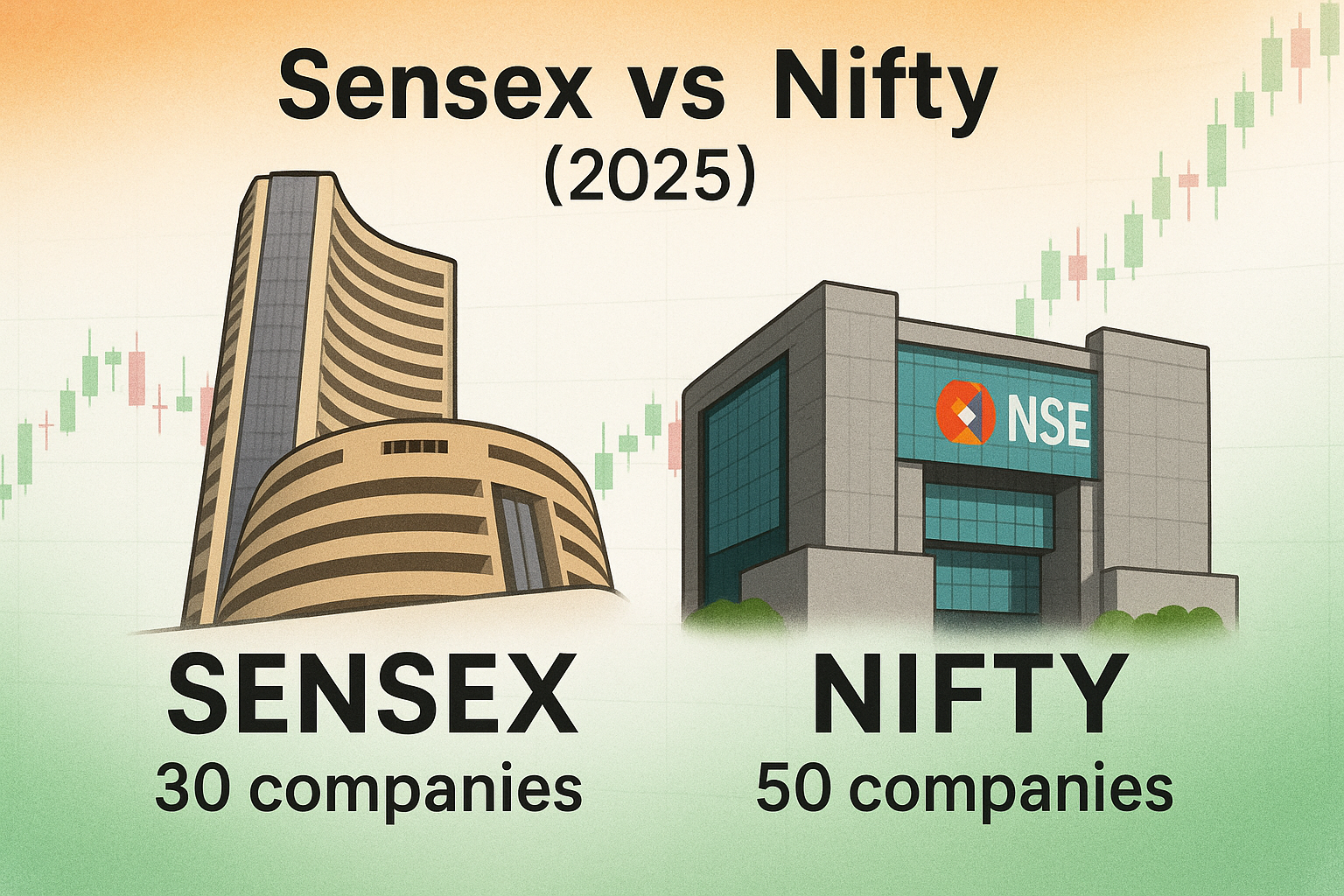
- Sensex tracks the top 30 companies on the Bombay Stock Exchange (BSE).
- Nifty tracks the top 50 companies on the National Stock Exchange (NSE).
When you hear “Sensex is up 500 points,” it means the 30 biggest companies on the BSE are performing well.
Sensex vs. Nifty: Key Differences
While both indices serve as financial scoreboards for India, they have key differences.
| Feature | Sensex | Nifty |
| Full Form | Sensitive Index | National Stock Exchange Fifty (Nifty 50) |
| Exchange | BSE (India’s oldest) | NSE (India’s largest by volume) |
| Companies | 30 | 50 |
| Launch Year | 1986 | 1996 |
| Benchmark | Historic & globally recognized | Popular for trading, derivatives, and index funds |
- Sensex is like a thermometer for India’s corporate health, measuring how its top 30 companies are faring. Its long history makes it an iconic benchmark.
- Nifty casts a wider net with 50 companies across diverse sectors, offering a broader and more representative view of the Indian economy.
How Do They Work? The “Free-Float” Method
Both indices are calculated using a unique method called free-float market capitalization. This doesn’t simply add up a company’s total shares. Instead, it only considers the shares that are actually available for public trading, excluding those held by promoters or governments that aren’t likely to be sold. This gives a more accurate picture of the market’s true value.
Why Do They Matter to You?
Understanding Sensex and Nifty is your first step to becoming a smart investor.
- Market Mood: They signal whether the market is bullish (rising) or bearish (falling), helping you gauge investor sentiment.
- Benchmark for Funds: Mutual funds and ETFs use these indices as a benchmark to measure their own performance. If your fund underperforms the Nifty, it’s a signal to review your investment.
- Your Wallet: You can’t invest in the indices directly, but you can buy index funds or ETFs that mimic them. For example, investing in a Nifty 50 Index Fund means your money will track the performance of the 50 top companies in the same proportions. If Nifty was at 12,000 in 2020 and is now at 25,170, your investment would have more than doubled (before taxes).
Which Is Better for Beginners: Sensex or Nifty?
While both are vital, the Nifty 50 is often the more popular and practical choice for beginners in 2025. Its broader coverage makes it a more diverse and easily accessible option for investment products like index funds. However, keep in mind that indices only track top companies and can still fall sharply during economic crises. Returns are never guaranteed.
Final takeaway: Sensex and Nifty are India’s financial scoreboards. Sensex is historic and tracks 30 companies, while Nifty is broader and tracks 50. For new investors, a Nifty 50 index fund is often the simplest and most common entry point to the market.