The Robo-Advisor Revolution: Is AI Managing Your Money Better Than You Can?

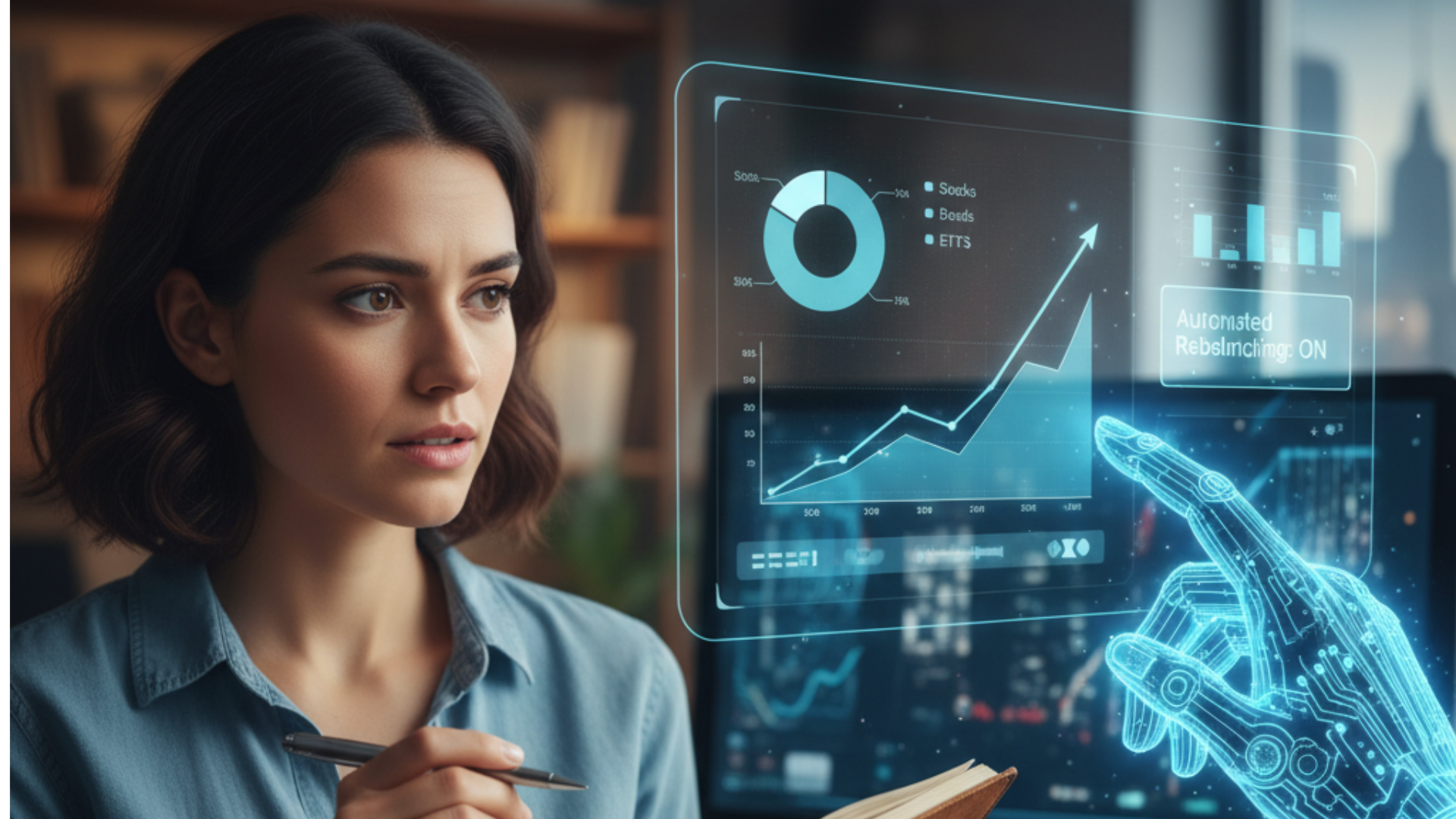
You’ve seen them everywhere. Wealthfront, Betterment, Schwab Intelligent Portfolios. The “robo-advisor” is no longer a niche curiosity, it’s a full-blown revolution. The global market for these platforms is exploding, projected to grow from around $10 billion in 2025 to over $70 billion by 2032.
The central promise is tantalizing: a sophisticated, data-driven investing strategy, once reserved for the ultra-wealthy, is now available to you for a fraction of the cost.
But the question in the title isn’t just about cost. It’s about performance. Is an algorithm a cold, unfeeling string of code genuinely better at managing your money than you are?
The answer is complicated. It turns out, the AI isn’t designed to be better than a perfect investor. It’s designed to be better than you the emotional, impulsive, and wonderfully human investor who gets scared in a crash and greedy in a bubble.
Your Biggest Enemy: The Investor in the Mirror
Let’s be honest. As human investors, we are often our own worst enemies. We are wired with psychological biases that cost us real money.
- Herd Behavior: When the market soars, we feel “FOMO” (Fear Of Missing Out) and pile in at the top.
- Panic Selling: When the market crashes, our “loss aversion” (the pain of losing is twice as powerful as the pleasure of gaining) kicks in, and we sell everything at the bottom.
- The Disposition Effect: We love to sell our winners too early to “lock in a gain” and hold our losers for way too long, praying they’ll “come back to even.”
This is the “behavior gap” the difference between what the market returns and what the average investor actually earns. And that gap is almost always caused by emotion.
This is where the AI steps in. A robo-advisor isn’t “smart” because it can predict the future. It’s “smart” because it has no emotions. It’s designed to execute a winning strategy with the one thing we lack: perfect, robotic discipline.
Peeking Inside the “AI” Black Box
The term “AI” sounds complex, but the engine behind most robo-advisors runs on four simple, proven concepts. This isn’t magic; it’s just math and discipline.
- The “Brain”: Modern Portfolio Theory (MPT) This is the Nobel Prize-winning framework that powers it all. The big idea? Don’t just pick “good” stocks. Instead, build a portfolio of assets (like stocks and bonds) that don’t all move in the same direction. The goal is to get the highest possible return for the level of risk you’re willing to take. The AI is simply the calculator that does this complex math for you.
- The “Tools”: Low-Cost ETFs The AI doesn’t buy individual stocks. It builds your MPT-based portfolio using low-cost Exchange-Traded Funds (ETFs). Think of an ETF as a basket that holds hundreds or even thousands of different stocks (e.g., a “U.S. Large Company” ETF or an “Emerging Markets” ETF). This gives you instant, massive diversification, so if one company goes bankrupt, your portfolio barely notices.
- The “Discipline”: Automatic Rebalancing This is the robo’s most powerful feature for fighting your emotions. Let’s say your target is a 60% stock / 40% bond portfolio.
- After a good year for stocks, your portfolio might “drift” to 70% stocks / 30% bonds. You are now taking on more risk than you intended.
- What you want to do: “Let my winners run! Stocks are hot!”
- What the robo-advisor does: It automatically sells 10% of your stocks (selling high) and buys 10% more bonds (buying low), bringing you back to your 60/40 target. It forces the “buy low, sell high” discipline that humans find so difficult.
- The “Bonus”: Tax-Loss Harvesting This is a sophisticated trick robos do automatically. When one of your ETFs is down, the robo will sell it to “harvest” the loss. You can then use that “capital loss” to offset capital gains on other investments, lowering your tax bill. The robo then immediately buys a similar (but not identical) ETF, so you stay fully invested. It’s like turning a market dip into a tax refund.
The Real Question: Can a Robot “Hold Your Hand”?
So, the robo-advisor is a disciplined, low-cost, tax-efficient machine. Case closed?
Not quite. We’ve established that we should rely on AI, but can we trust it?
This is the core of the human vs. machine debate.
- Reliance is logical. We rely on a tool (like a calculator) because it’s predictable, transparent, and accurate. The section above explains why you can rely on a robo-advisor.
- Trust is emotional. We trust people based on empathy, shared values, and connection.
During a calm, rising market, “reliance” is all you need.
But what about during a 2008-style financial crisis? When the news is terrifying and your account is down 30%, logging into a platform that simply says, “STAY THE COURSE,” might not be enough. You might panic, pull all your money out, and lock in those devastating losses.
This is the one place a human advisor has an unassailable edge. A good human advisor’s real job isn’t just to pick investments; it’s to be a behavioral coach. It’s to get on the phone with you, listen to your fears, and say, “I understand. This is scary. But we built a plan for this. Do not sell.”
That emotional “hand-holding” can be the single most valuable service in investing.
The Verdict: The Revolution Isn’t AI vs. Human. It’s AI + Human.
For years, the debate has been framed as a binary choice: the old-school, high-fee human or the new-school, low-cost robot.
But the data shows the revolution is already over, and a clear winner has emerged: both.
Recent market data shows that “hybrid robo-advisors” are the dominant and fastest-growing part of the industry, accounting for over 60% of the market.
This “human-in-the-loop” model gives investors the best of both worlds:
- The AI handles 90% of the work: The data-crunching, the portfolio allocation, the daily rebalancing, and the tax-loss harvesting.
- The Human handles the 10% that matters most: The empathy, the wisdom, and the complex life planning.
An algorithm can’t help you plan for buying a house while saving for a child’s college, all while navigating a complex new job offer. A human can. The AI is the engine, but the human is the pilot, helping you navigate the storms and reach your destination.
So, is AI managing your money better than you can?
Yes. It is almost certainly better than your emotional self. But. The ultimate winner isn’t the AI. It’s you, when you combine the robotic discipline of the AI with the wisdom and guidance of a real human.
Read More like this :