Stock Market Explained: How It Works and Why It Matters in India 2025

The stock market is where dreams of wealth meet the reality of risk. In India, with over 20 crore demat accounts and ₹1.2 lakh crore in daily trades on the NSE in 2025, understanding how the stock market works is key to building financial freedom. Whether you’re a beginner exploring investing in India, a family planning your personal finance, or saving for essentials like health insurance, this guide simplifies the stock market with practical tips to start investing safely. From buying shares to avoiding common pitfalls, here’s why the stock market matters and how you can make it work for you in 2025.
1. What is the Stock Market?
The stock market is a platform where investors buy and sell shares of companies, like Reliance or TCS, to grow their wealth. In India, it operates through exchanges like the National Stock Exchange (NSE) and Bombay Stock Exchange (BSE), regulated by SEBI.
1.1 Definition and Purpose
- Definition: A digital marketplace for trading company shares and other securities (e.g., ETFs).
- Purpose: Companies raise funds for growth; investors earn returns via price appreciation or dividends.
- Example: Buying 10 shares of HDFC Bank at ₹1,600; if the price rises to ₹1,800, you gain ₹2,000.
1.2 Why It Matters in India
- Wealth Creation: Sensex grew 14% annually from 2020–2024; as of Sep 5, 2025, it’s at 80,710.76.
- Economic Impact: Funds startups and infrastructure, supporting India’s 7% GDP growth (RBI, FY26 estimate).
- Personal Finance: Stock market gains can fund goals like health insurance premiums or retirement (see our health insurance guide).
2. How the Stock Market Works in India
The stock market operates through a structured, regulated process. Here’s a detailed breakdown:
2.1 Stock Exchanges
- NSE and BSE: India’s primary exchanges; NSE handles ~90% of equity trading volume.
- Trading Hours: 9:15 AM–3:30 PM, Monday–Friday.
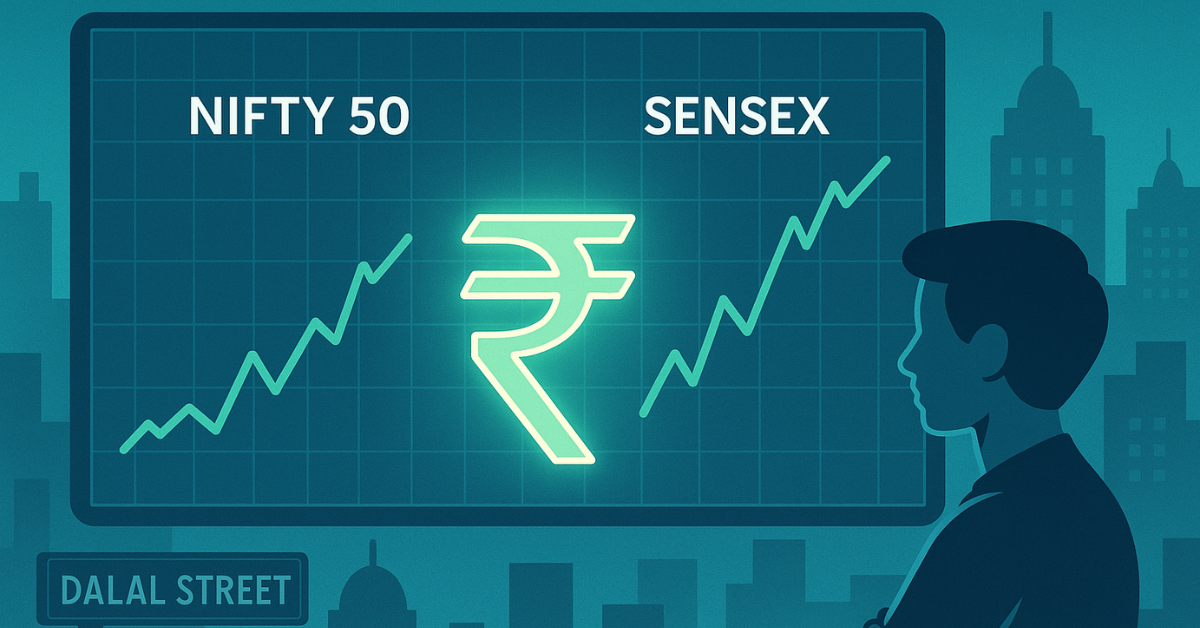
- Indices: Sensex (30 blue-chip stocks), Nifty 50 (50 stocks); Bank Nifty at 54,114.55 (Sep 2025).
- 2025 Stats: NSE lists 2,697 companies; daily turnover ₹1.03 lakh crore (Aug 2025).
2.2 Buying and Selling Shares
- Process: Investors use brokers (e.g., Zerodha, Groww) to place orders via demat accounts.
- Order Types:
- Market Order: Buy/sell at current price.
- Limit Order: Set a specific price (e.g., buy at ₹500).
- Stop-Loss: Auto-sell if price drops (e.g., 10% below purchase).
- Settlement: T+1 (funds/shares credited next day).
2.3 Role of Regulators
- SEBI: Ensures transparency, prevents fraud; reduced scams by 25% in 2023–24.
- RBI: Influences markets via monetary policy (repo rate 6.5% in 2025).
- Example: SEBI’s rules protect against pump-and-dump schemes.
2.4 Market Participants
- Retail Investors: Individuals like you; 20 crore+ demat accounts.
- Institutional Investors: Mutual funds, FIIs ($20 billion inflows, H1 2025).
- Algo Traders: Drive 50% of volume, adding volatility.
2.5 Factors Driving Stock Prices
- Company Performance: Earnings, revenue growth (e.g., Infosys Q1 FY26 profit up 8%).
- Economic Indicators: Inflation (4.5%), GDP growth (7.8% Q1 FY26).
- Global Events: US Fed rate hikes, oil prices.
- Sentiment: News, social media (e.g., X posts on IPOs).
3. Types of Stock Market Investments
The Indian stock market offers various options, each with different risks and rewards:
3.1 Equity Shares
- What: Ownership in companies (e.g., Tata Motors, ₹500/share).
- Returns: Capital gains (price rise), dividends (e.g., 2% yield).
- Risk: High; Sensex dropped 3% in July 2025.
- Best for: Long-term investors (5+ years).
3.2 Exchange-Traded Funds (ETFs)
- What: Funds tracking indices (e.g., Nifty 50 ETF).
- Returns: 12–15% annually (historical).
- Risk: Medium; diversified across stocks.
- Example: ₹10,000 in a Nifty ETF could grow to ₹20,000 in 5 years at 15%.
3.3 Derivatives (F&O)
- What: Futures/options tied to stocks/indices.
- Risk: Very high; 91% retail traders lost ₹1.06 lakh crore in FY25 (SEBI).
- Best for: Experts only.
3.4 Initial Public Offerings (IPOs)
- What: Buying shares when a company goes public.
- Example: Zomato IPO (2021) gave 80% returns in months.
- Risk: High; oversubscription common in 2025.
4. How to Start Investing in the Stock Market
Follow these steps to invest safely in 2025:
4.1 Set Financial Goals
- Short-Term: Emergency fund, vacation (1–3 years).
- Long-Term: Retirement, education (5+ years).
- Integration: Use gains for health insurance premiums (₹10,000–20,000/year).
4.2 Assess Risk Tolerance
- Conservative: ETFs, blue-chip stocks (e.g., HDFC Bank).
- Aggressive: Small-cap stocks, IPOs.
- Tool: NSE’s risk profiler quiz.
4.3 Open a Demat Account
- Brokers: Zerodha (₹0 delivery), Groww (user-friendly).
- Process: Online KYC (PAN, Aadhaar); 10 minutes.
- Costs: Free opening; ₹300/year maintenance.
4.4 Research Stocks
- Tools: Moneycontrol, Screener.in, BSE India.
- Metrics: P/E ratio (<20 for value), EPS, dividend yield (>2%).
- Example: Reliance P/E ~25, suitable for growth investors.
4.5 Start Small
- Investment: ₹1,000 in ETFs or ₹5,000 in blue-chip stocks.
- Strategy: Dollar-cost averaging (invest fixed amounts monthly).
4.6 Monitor and Rebalance
- Frequency: Quarterly reviews.
- Tool: Broker apps (e.g., Zerodha Kite alerts).
- Tip: Rebalance if one stock >30% of portfolio.
5. Why the Stock Market Matters for Your Finances
The stock market is a powerful tool for personal finance:
- Wealth Growth: ₹10,000 invested in Sensex in 2020 is ~₹18,000 in 2025 (14% CAGR).
- Inflation Protection: Outpaces 4.5% inflation (2025).
- Financial Goals: Funds health insurance (see our guide), education, or retirement.
- Risk Management: Diversification reduces losses; SEBI protects against fraud.
6. Common Mistakes to Avoid
Avoid these pitfalls to protect your money:
- Chasing Hype: Ignore social media trends (e.g., meme stocks).
- Overtrading: Fees (₹20/trade) erode gains.
- Ignoring Risk: F&O losses hit ₹1.06 lakh crore in FY25.
- No Plan: Use our budget planner to allocate funds.
- Scams: Verify brokers on SEBI’s website.
7. Frequently Asked Questions (FAQ)
7.1 What is the stock market?
A platform to buy/sell company shares, like NSE/BSE, regulated by SEBI.
7.2 How do beginners start investing in India’s stock market?
Open a demat account, start with ₹1,000 in ETFs, and research via Moneycontrol.
7.3 Is the stock market safe?
Yes, with SEBI oversight; but diversify to manage risks (91% F&O traders lose money).
7.4 How does the stock market tie to personal finance?
Gains fund goals like health insurance or retirement, with tax benefits (LTCG 12.5%).
7.5 What are the best stocks for 2025?
Blue-chips (Reliance, HDFC Bank); ETFs for diversification.
8. Conclusion
India’s stock market is your gateway to wealth in 2025, with Sensex at 80,710 and 20 crore demat accounts driving growth. By understanding how it works, starting small, and avoiding mistakes, you can achieve financial freedom. Pair stock market investing with personal finance strategies like budgeting and health insurance for a secure future. Start today: Open a demat account, invest ₹1,000, and take control of your wealth!
Explore More : Sensex Vs Nifty