How the Indian Financial Market Works: A Comprehensive Guide for Beginners in 2025

India’s financial markets are a vibrant ecosystem driving economic growth and wealth creation. As of September 2025, with over 20 crore demat accounts and a combined average daily turnover in the cash equity segment exceeding ₹1 lakh crore across NSE and BSE, understanding how the Indian financial market works is essential for anyone looking to invest wisely. This detailed guide covers every aspect, from basics to advanced strategies, tailored for beginners, families, and young professionals in India. Whether you’re exploring investing in India, managing personal finance, or linking investments to essentials like health insurance, we’ll break down each point with examples, statistics, and practical tips. By the end, you’ll have the tools to start investing confidently in 2025.
1. What is the Indian Financial Market?
The Indian financial market is a structured system where buyers and sellers trade financial instruments such as stocks, bonds, currencies, and derivatives. It facilitates the flow of capital from investors to businesses and governments, supporting India’s economy.
1.1 Definition and Core Purpose
- Basic Definition: It’s a marketplace for financial assets, operating digitally through exchanges like NSE and BSE.
- Purpose: Allocates savings to productive uses, enables risk management, and promotes economic stability.
- Example: A company like Reliance issues shares to raise funds for expansion, while investors buy them expecting returns.
1.2 Historical Evolution
- Origins: Started with BSE in 1875 as Asia’s oldest stock exchange.
- Key Milestones: NSE established in 1992; dematerialization (demat) in 1996; online trading boom post-2000.
- 2025 Context: Digitalization has led to 20 crore+ demat accounts (up from 19.4 crore in mid-2025, per SEBI data), driven by apps like Groww and Zerodha.
1.3 Why It Matters in 2025
- Economic Growth: Contributes to India’s projected 6.5-7.8% GDP growth in FY26 (RBI estimates), funding infrastructure and startups.
- Wealth Creation: Sensex grew ~14% annually from 2020-2024; as of Sep 5, 2025, Sensex stands at 80,710.76.
- Personal Finance Integration: Investments can fund goals like retirement or health insurance premiums, providing financial security amid rising costs.
- Challenges: Volatility from global events (e.g., US rate hikes) and high F&O losses (₹1.06 lakh crore in FY25 for retail investors, per SEBI).
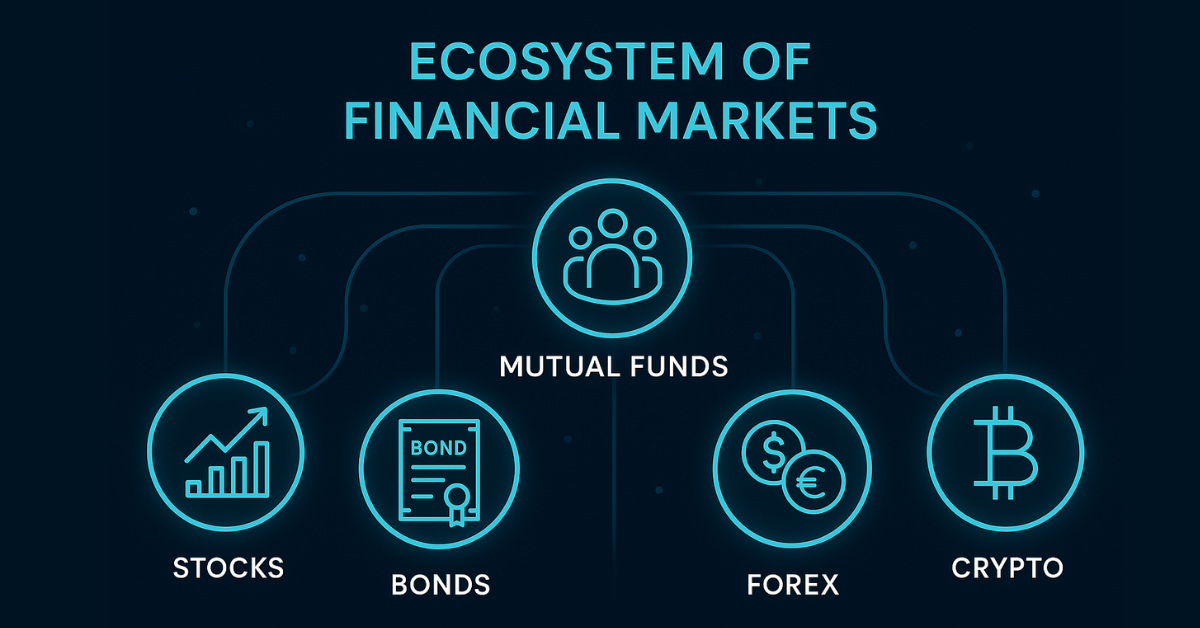
2. Key Components of the Indian Financial Market
The market is divided into segments, each with specific instruments, participants, and rules.
2.1 Stock Market (Equity Market)
- What It Is: Trading of company shares on exchanges.
- Exchanges: NSE (National Stock Exchange, handles ~90% volume) and BSE (Bombay Stock Exchange).
- Instruments: Equity shares, ETFs (Exchange-Traded Funds).
- How It Works: Companies list via IPOs; prices fluctuate based on supply-demand, earnings, and news.
- 2025 Stats: NSE lists 2,697 domestic companies; Sensex at 80,710.76, Nifty at 24,741 (Sep 5, 2025).
- Example: Buying Tata Motors shares at ₹500; if it rises to ₹600, you gain 20%.
- Risks and Returns: High potential (10-20% annual); but volatile—Sensex fell 3% in July 2025.
For More Detail: Read
2.2 Bond Market (Debt Market)
- What It Is: Trading of debt securities where issuers borrow from investors.
- Types: Government bonds (G-Secs), corporate bonds, municipal bonds.
- Exchanges: NSE, BSE; RBI manages G-Secs.
- How It Works: Investors lend money for fixed interest (coupon rate); bonds mature with principal repayment.
- 2025 Stats: Bond yields ~6-8%; RBI bonds popular for safety.
- Example: Investing ₹1 lakh in a 7% RBI bond yields ₹7,000 annual interest.
- Risks and Returns: Low risk (especially G-Secs); returns 6-8%, ideal for conservative investors.
For More Detail: Read
2.3 Mutual Funds Market
- What It Is: Pooled investments managed by professionals.
- Types: Equity funds (stock-focused), debt funds (bonds), hybrid (mix).
- Regulator: SEBI; AMFI (Association of Mutual Funds in India) oversees.
- How It Works: Investors buy units; fund managers invest in diversified portfolios.
- 2025 Stats: Equity MFs averaged 17.67% returns; top funds like HDFC Flexi Cap gave 6.62% YTD.
- Example: ₹500/month SIP in SBI Bluechip Fund; historical 12-15% annual returns.
- Risks and Returns: Medium (diversified); 12-20% for equity funds over 5 years.
For More Detail : Read
2.4 Money Market
- What It Is: Short-term borrowing/lending (up to 1 year).
- Instruments: Treasury bills, commercial papers, certificates of deposit.
- Participants: Banks, corporates; RBI regulates.
- How It Works: Provides liquidity; rates influenced by RBI’s repo rate (6.5% in 2025).
- 2025 Stats: Low yields (4-6%); used for parking short-term funds.
- Example: A company issues commercial paper at 5% for 90 days to meet payroll.
For More Detail : Read
2.5 Derivatives Market
- What It Is: Contracts deriving value from underlying assets (stocks, indices).
- Types: Futures, options (F&O), forwards, swaps.
- Exchanges: NSE dominates (~99% volume).
- How It Works: Speculate or hedge; settle in cash or delivery.
- 2025 Stats: High turnover; 91% retail traders lost money in FY25 (₹1.06 lakh crore net loss, SEBI study).
- Example: Buying Nifty futures at 24,741; profit if index rises.
- Risks and Returns: Very high risk; suitable for experts only.
For More Detail : Read
2.6 Forex and Commodity Markets
- Forex: Currency trading (e.g., INR/USD); RBI regulates.
- Commodities: Gold, oil via MCX/NCDEX.
- 2025 Stats: Forex turnover ~$50 billion daily; commodities volatile due to global prices.
For More Detail : Read
3. How the Indian Financial Market Functions
The market operates through interconnected players, processes, and regulations.
3.1 Role of Regulators
- SEBI: Protects investors, regulates exchanges/MFs; reduced scams by 25% in 2023-24.
- RBI: Manages monetary policy, forex, bonds; sets repo rate at 6.5% for FY26.
- IRDAI: Oversees insurance-linked investments.
- Enforcement: Penalties for fraud; investor education portals.
3.2 Stock Exchanges and Trading Mechanisms
- NSE/BSE: Electronic platforms; trading hours 9:15 AM-3:30 PM.
- Order Types: Market, limit, stop-loss.
- Clearing/Settlement: T+1 cycle (next day settlement).
- 2025 Stats: NSE daily turnover ₹1.03 lakh crore (Aug 2025, combined with BSE).
3.3 Market Participants and Their Roles
- Retail Investors: 20 crore+ demat holders; drive 40% volume.
- Institutional: Mutual funds, FIIs (foreign inflows $20 billion in H1 2025).
- Brokers/Intermediaries: Zerodha, Upstox; charge 0-₹20/trade.
- Algo Traders: 50% of volume; increase volatility.
3.4 Market Indices and Benchmarks
- Sensex: 30 blue-chip stocks on BSE.
- Nifty 50: 50 stocks on NSE.
- Other: Bank Nifty (54,114.55 as of Sep 2025).
- Usage: Track performance; basis for ETFs/F&O.
3.5 Factors Influencing Market Movements
- Economic Indicators: GDP (7.8% Q1 FY26), inflation (4.5%).
- Global Events: US Fed rates, oil prices.
- Corporate Earnings: Q1 FY26 saw 10% profit growth.
- Sentiment: News, elections impact volatility.
4. How to Start Investing in the Indian Financial Market
Step-by-step guide with full details.
4.1 Set Clear Financial Goals
- Short-Term (1-3 years): Emergency fund, vacation (use FDs/debt MFs).
- Medium-Term (3-5 years): Home downpayment (hybrid MFs).
- Long-Term (5+ years): Retirement, education (equity MFs/stocks).
- Integration: Allocate for health insurance (₹10,000-20,000 annual premium).
4.2 Understand Risk Tolerance and Profile
- Conservative: FDs/bonds (low risk, 6-7% returns).
- Moderate: Hybrid MFs (8-12% returns).
- Aggressive: Stocks/F&O (15%+ but high volatility).
- Assessment: Use online quizzes from NSE/SEBI.
4.3 Open a Demat and Trading Account
- Requirements: PAN, Aadhaar, bank account.
- Brokers: Zerodha (₹0 equity delivery), Groww (user-friendly).
- Process: Online KYC (10 mins); fund via UPI.
- Costs: Account opening free; maintenance ₹300/year.
4.4 Choose Investment Instruments
- Beginners: Start with MFs (₹500 SIP).
- Diversification: 50% equity, 30% debt, 20% gold.
- Tax Aspects: LTCG >₹1 lakh at 12.5% (stocks/MFs).
4.5 Research and Analyze Investments
- Tools: Moneycontrol (charts), Screener.in (ratios like P/E <20).
- Metrics: EPS, dividend yield, ROE (>15%).
- Sources: Company reports, SEBI filings.
4.6 Execute and Monitor Investments
- Buy/Sell: Via app; set alerts.
- Review: Quarterly; rebalance annually.
- Exit Strategy: Stop-loss at 10% drop.
4.7 Leverage Technology and Apps
- Apps: Groww, Zerodha Kite, ET Money.
- Features: SIP calculators, robo-advisors.
5. Common Mistakes to Avoid in the Indian Financial Market
Detailed pitfalls with prevention tips.
5.1 Emotional Investing
- Issue: Panic selling during crashes (e.g., 3% Nifty drop in July 2025).
- Avoid: Stick to long-term plans; ignore short-term noise.
5.2 Overtrading and High-Risk Bets
- Issue: 91% F&O losses (₹1.06 lakh crore in FY25).
- Avoid: Limit trades; avoid leverage if beginner.
5.3 Ignoring Diversification
- Issue: All eggs in one stock (e.g., banking sector volatility).
- Avoid: Spread across sectors/assets.
5.4 Falling for Scams
- Issue: Fake apps promising 20%+ guaranteed returns.
- Avoid: Verify with SEBI; use registered brokers.
5.5 Neglecting Costs and Taxes
- Issue: Brokerage/STT eat returns.
- Avoid: Choose low-cost brokers; claim Section 80C deductions.
5.6 Skipping Financial Planning
- Issue: Investments without budget.
- Avoid: Use monthly budget planner; prioritize health insurance.
6. Frequently Asked Questions (FAQ)
6.1 What is the Indian financial market?
A system for trading financial assets, regulated by SEBI/RBI, with segments like stocks and bonds.
6.2 How can beginners start investing in India?
Open demat account, start SIPs, research via Moneycontrol.
6.3 Is the Indian financial market safe?
Yes, with regulations; but risks exist—91% F&O traders lose money.
6.4 How does investing tie to personal finance?
Grows wealth for goals like health insurance (tax benefits under 80D).
6.5 What are the best investments in 2025?
Mutual funds (17% avg returns), stocks for growth, bonds for stability.
7. Conclusion
The Indian financial market offers immense potential in 2025, with robust growth (Sensex at 80,710) and accessibility (20 crore demat accounts). By understanding each component, starting small, and avoiding mistakes, you can achieve financial independence. Integrate with personal finance tools like budgeting and health insurance for holistic security. Start today: Open a demat account, invest ₹500 in a MF SIP, and monitor progress. Remember, consult advisors—investing involves risks.